
LED strip and feature lighting
Under-cabinet, coving and feature lighting, driven and hidden properly.
In short
LED strip is the fitting that most often disappoints, and almost always for the same two reasons: the strip is visible, or the driver was an afterthought. Strip should be hidden behind a lip, a coving edge or a channel so you see the light and not the diodes, and every run needs a driver of the right wattage sitting somewhere it can be reached when it eventually fails. Get those right and it is the cheapest way to make a room look considered.
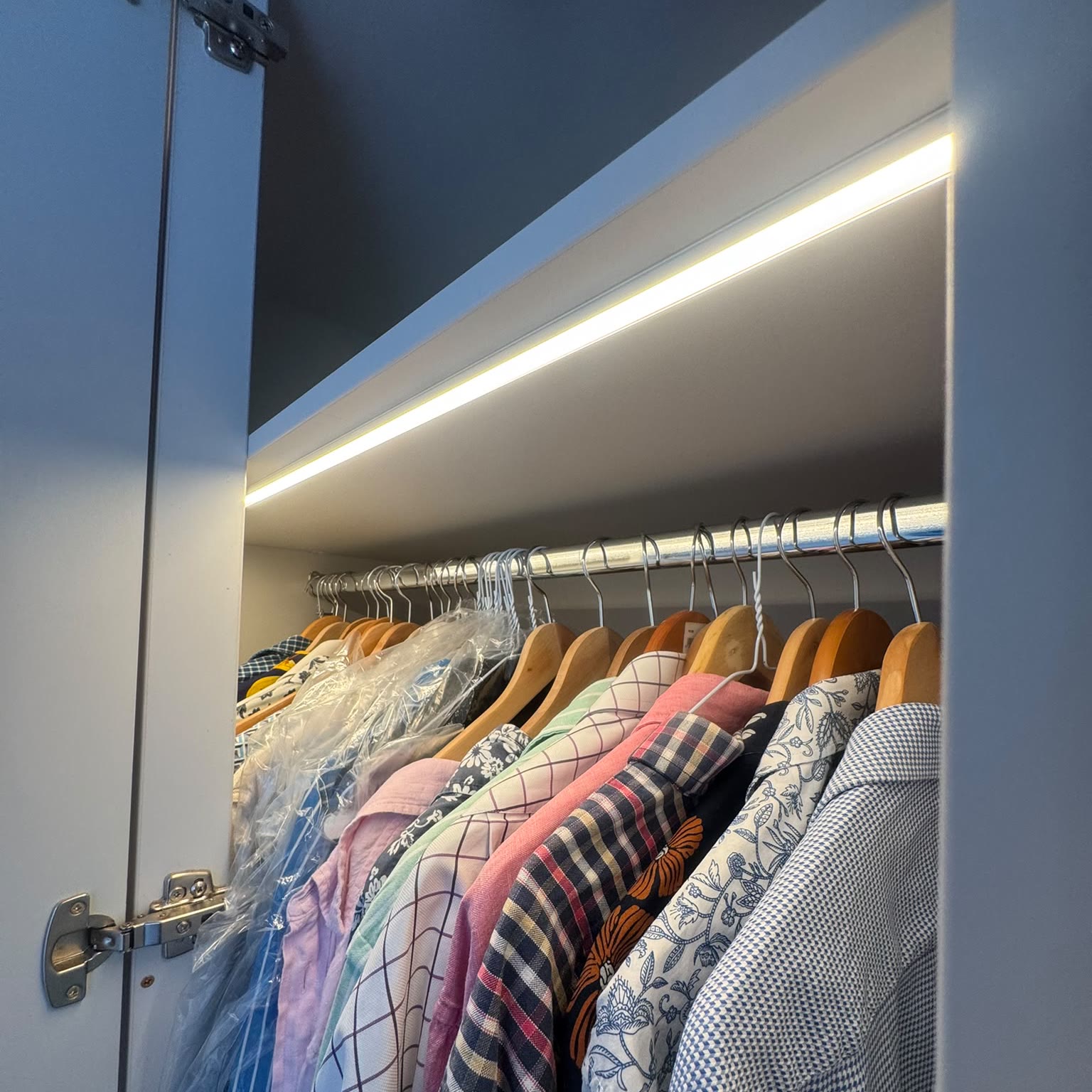
Strip lighting is used well when you cannot see where it is coming from. Under a run of wall units, behind a coving lip, along the underside of a floating shelf. Used badly it is a bright line of dots reflected in a gloss worktop.
What makes strip lighting look good or cheap
This is what we look at before ordering anything. We supply the fittings as well as installing them, so you can leave the sourcing to us: tell us the look you are after and we will find something that works in your room. If you have already bought something, send us a photo or a link and we will tell you what it needs.
Every run needs one, it is the part most likely to fail, and it has to be reachable without dismantling the kitchen. Deciding this at the end is how drivers end up sealed behind plasterboard.
A low-density strip gives a visible line of dots, especially in a diffuser or reflected in a gloss surface. Higher density costs more and is the difference between a line of light and a row of spots.
Aluminium channel does two things: it hides the strip and it takes heat away, which is what LED strip life actually depends on. Strip stuck straight to a warm surface with its own adhesive is the usual reason a run dies early.
Strip is often bought separately from the rest of the lighting and ends up a different white. In a kitchen with 3000K downlights, 3000K strip.
Under-cabinet lighting is far more useful on its own switch than tied to the main light, and it makes a good low-level light on its own in the evening.
What fitting one involves
Work out what it is lighting
A worktop, a wall, a shelf edge. That decides the position, the direction and how bright it needs to be.
Plan the driver and the route
Driver positioned somewhere accessible, with the supply run to it before anything is boxed in or plastered.
Fit the channel
Channel or diffuser fixed so the strip is hidden from normal sightlines and has something to lose heat into.
Install, switch and test
Strip fitted, connected, switched as its own group, and the circuit tested.
Got a fitting in mind?
Send a photo of it and of the room to 07557 448945 on WhatsApp. You will get a straight answer on whether it will work where you want it.
Frequently asked questions
Why has my LED strip gone dim in patches?
Usually heat or voltage drop. Strip stuck to a surface with no channel to take heat away degrades unevenly, and a long run fed from one end gets dimmer towards the far end. Both are avoidable at installation and awkward to fix afterwards.
Can LED strip be dimmed?
Yes, but it is dimmed at the driver rather than with a normal wall dimmer, so the driver has to be a dimmable one and matched to a compatible control. Worth deciding before it is installed, because changing it later means getting back to the driver.
Where does the driver go?
Somewhere it can be reached. Inside a wall unit, in an accessible void, or in a cupboard. It is the component most likely to need replacing, and sealing one behind plasterboard turns a ten-minute job into a repair.
Can you fit strip lighting into coving?
Yes, and it is one of the best uses of it, provided there is a lip deep enough to hide the strip and enough gap above for the light to wash the ceiling. If the coving is already up it is worth checking the profile before ordering anything.
Having the work done
This page is about choosing a fitting. For the installation itself, including new circuits, switching and dimming, see lighting and LED installations. We cover Derbyshire and Nottinghamshire — see areas we cover.
Held by Stephen Sparham. Every job that needs one is tested and certificated. More about our qualifications