
Outdoor and garden lighting
Garden, patio and security lighting specified for being outside.
In short
Outdoor lighting has to survive water, cold and being strimmed, none of which apply indoors. That means an IP rating chosen for where the fitting actually sits, RCD protection on the circuit, and cable that is either armoured and buried at a proper depth or run in suitable containment. The design question is simpler than people expect: light the things you want to see, not the whole garden. Aiming light down onto planting, steps and paths gives a far better result than flooding the lawn, and does not annoy the neighbours.
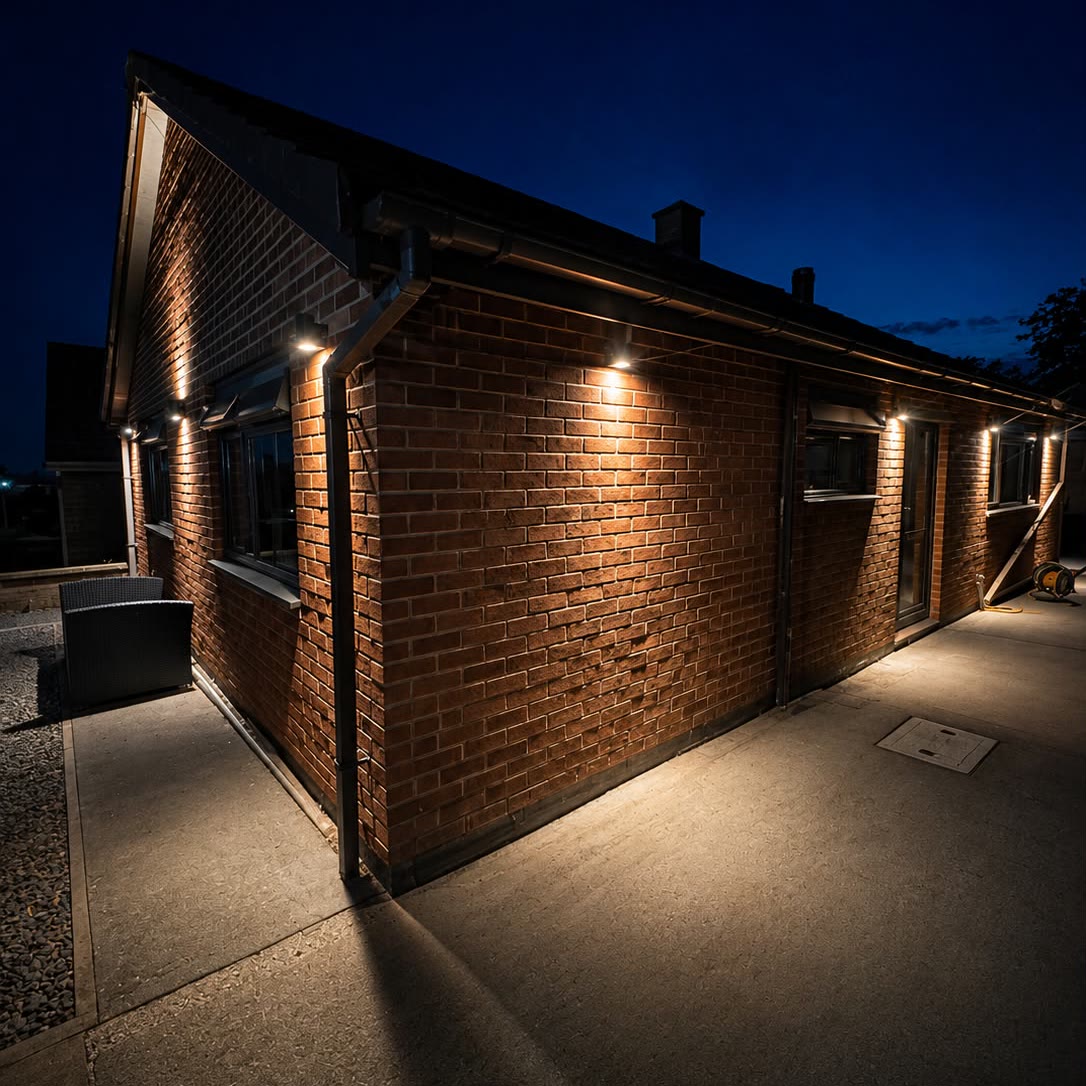
Most gardens are lit by one very bright floodlight that makes everything outside its beam look darker. A few low-level fittings, aimed at something, transform a garden in a way a floodlight never does.
What outdoor fittings have to cope with
This is what we look at before ordering anything. We supply the fittings as well as installing them, so you can leave the sourcing to us: tell us the look you are after and we will find something that works in your room. If you have already bought something, send us a photo or a link and we will tell you what it needs.
Not just "outdoor". A fitting on a sheltered wall and one sitting in a border collecting water need different ratings. Spike lights in planting have the hardest life of any fitting we install.
Low-voltage garden systems run from a transformer and are easier to extend later. Mains fittings are brighter and more permanent. Both need doing properly; the difference is mostly in how the cable is run.
Distance matters far more outdoors than indoors, and a run to the bottom of a garden needs planning around what you dig through. Straight runs along known lines are easier to avoid later than something that wanders across a lawn.
Two different jobs. A PIR floodlight over a side gate is security. Lighting a patio for sitting out is not, and one does not do the other well.
Fittings that throw light upward or across a boundary cause more complaints than any other outdoor job. Aiming down is almost always the better result as well as the more neighbourly one.
What fitting one involves
Walk the garden
In the dark if we can, because what a garden needs at night is rarely what it looks like it needs in daylight.
Plan the route and the load
What it feeds and how far it has to travel decide the cable size and the protection.
Install the supply
Armoured cable buried at a proper depth with marker tape above it, or run in suitable containment where burying is not possible.
Fit and aim
Fittings positioned and aimed at planting, steps and paths, with switching and timers set up so the garden is not all on one switch.
Test and certificate
The circuit tested including RCD operation, which is what protects anyone using a socket or a mower outside.
Got a fitting in mind?
Send a photo of it and of the room to 07557 448945 on WhatsApp. You will get a straight answer on whether it will work where you want it.
Frequently asked questions
Do outdoor lights need RCD protection?
Yes. Anything outdoors, and any socket likely to be used outdoors, needs RCD protection. It is one of the clearest safety requirements there is, and it is what protects somebody using a mower or a hedge trimmer.
Can you run power to the bottom of the garden?
Yes, with armoured cable buried at a proper depth and marker tape laid above it so anybody digging later finds the warning before the cable. The distance affects the cable size, so a long run is worth planning rather than guessing.
Will garden lighting annoy my neighbours?
Only if it is aimed badly. Light thrown upward or across a boundary is the single most common cause of complaints. Aiming down onto planting, paths and steps looks better and does not light up next door.
Is low-voltage garden lighting worth it?
For planting and path lighting, often yes: the cable is easier to run and extend, and it is simple to add to later. For security lighting or anything that needs to be bright, mains is usually the better answer.
Having the work done
This page is about choosing a fitting. For the installation itself, including new circuits, switching and dimming, see lighting and LED installations. We cover Derbyshire and Nottinghamshire — see areas we cover.
Held by Stephen Sparham. Every job that needs one is tested and certificated. More about our qualifications